RCS
Rich Communication Services
The GSMA standard for messages with images, buttons and receipts in the phone's built-in messaging app, the successor to SMS.
Read more:
What is RCS Messaging and Why It Matters in 2026

The terms of RCS for Business, explained in one line each. Every term links to the article that explains more.
What RCS is, who is behind it and who sends.
The GSMA standard for messages with images, buttons and receipts in the phone's built-in messaging app, the successor to SMS.
The part of RCS where businesses send to customers and receive replies, through Google's platform and an approved agent. Called RBM, RCS Business Messaging, until September 2025.
The GSMA's common specification of the RCS features, so that RCS works the same across operators and phone manufacturers.
Google's platform for RCS, which many operators use instead of building their own.
The settings the operator delivers to iPhone. That is where RCS is switched on, operator by operator.
The business's sender in RCS: name, logo, colour, description and contact details.
An agent whose brand has been reviewed. The recipient sees a name, a logo and a verification badge instead of a number.
A button, link or QR code that opens a thread with the business's agent, so that the customer can write first.
Only the sender and the recipient can read the message. Apple has added it for RCS between iPhone and Android in iOS 26.5, in beta according to Apple; the state in Sweden is on the status page.
What an RCS message can contain.
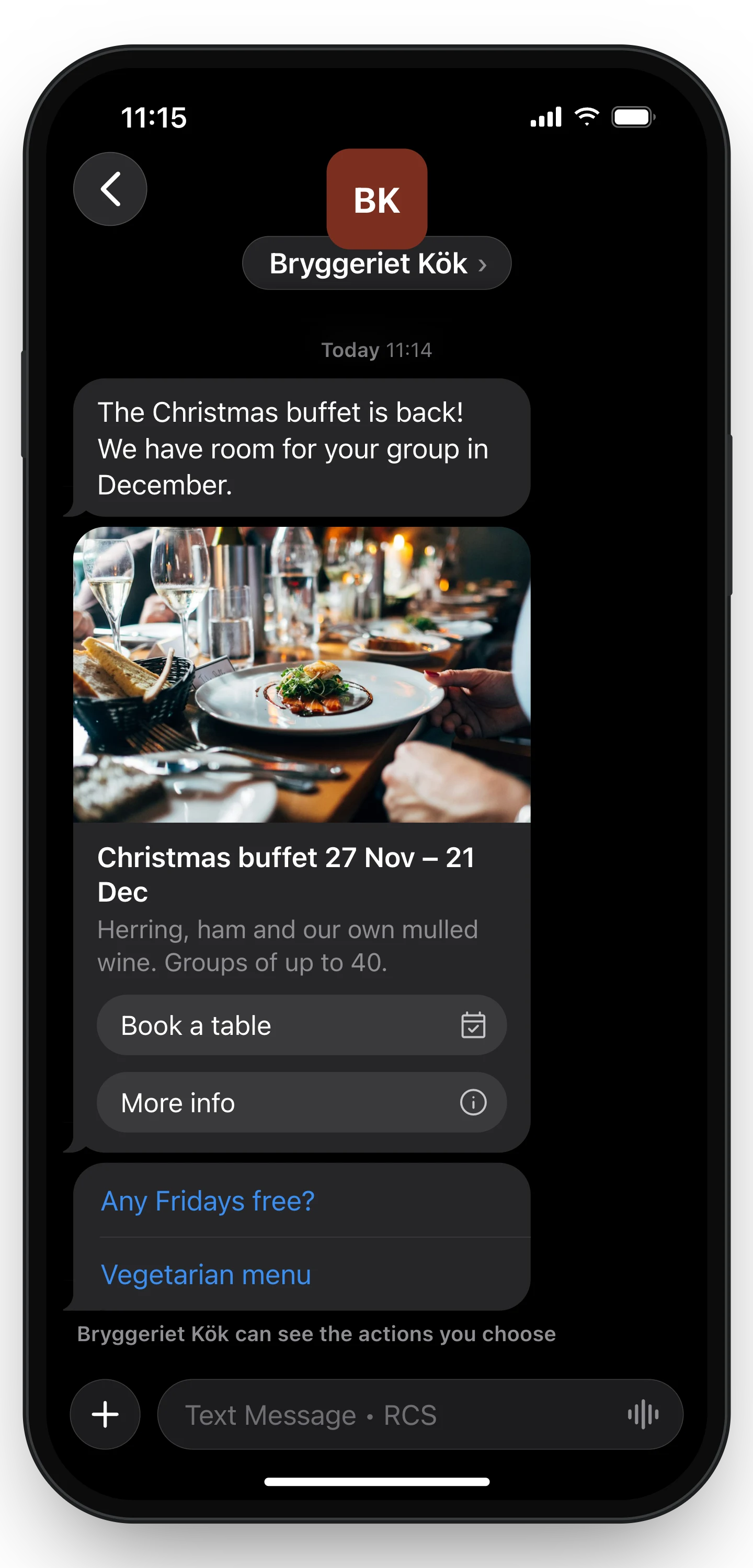
A message with an image or video, a title, text and buttons in one card.
Several rich cards side by side that the recipient swipes between.
A ready-made reply as a button. The tap sends the reply back to you, as text and as data your system can read.
A button that does something on the phone: opens a link, makes a call, shows a location or adds a calendar event.
Which image, video and file formats RCS accepts and how large they may be.
How the message gets through, and what you learn afterwards.
A query before sending whether the recipient's phone and operator can receive RCS.
If the recipient has no RCS, or RCS does not arrive in time, the same message is sent as SMS.
A notice to your system when the message has reached the phone.
A notice when the recipient has opened the message. The recipient can switch off read receipts on the phone.
The address in your system where the RCS API sends receipts, replies and button taps the moment they happen.
A pricing unit at some operators: a 24-hour window in which messages back and forth count as one conversation.
From registration to the first send, and the recipient's right to say no.
The check that the business has the right to use the name and logo in the agent.
Each operator approves the agent before it reaches that operator's customers.
Phone numbers allowed to receive the agent's messages before launch, to try it on real phones.
The agent is approved and can send to all recipients, not only to test numbers.
The recipient's choice not to receive more messages, for example by replying STOP or blocking the sender.
Missing a term? Write to info@spirius.com and we will add it.


